Investment Residency
My 2026 Guide to Cyprus Residency by Investment: Rules, Costs, and Timelines
2026 Cyprus residency-by-investment guide: routes, costs, VAT 5% vs 19%, timelines, KYC, and maintenance duties.
By
Bo
34 min read
Introduction
I finished my own Cyprus permanent residency-by-investment process this year. The biggest lesson I learned: this isn’t “buy a home and the paperwork happens.” It’s a rules-and-paperwork project with a property purchase attached.
For a non‑EU family looking for a stable European base, this guide is my attempt to share what I wish someone had handed me before I started: the rule framework most applicants are assessed against, what actually counts as a qualifying asset, how the real cost stack works (especially VAT), what timelines usually feel like in real life, and what I kept doing after approval to protect the status.
I also want to say thanks. I completed my application with support from Cyprus Immigration, and it made the process feel more structured and less stressful.
I’m writing as a regular applicant who took the new-build, first-sale route from a developer. I’m not a lawyer or a tax advisor, and this isn’t legal or tax advice. Policies evolve—so treat this as 2026 guidance and confirm the latest requirements, fees, and document rules with qualified Cyprus professionals at the time you file.
Cyprus Residency by Investment 2026: Rules and Eligibility
Many families searching Cyprus residency by investment 2026 end up looking at the fast‑track permanent residence route under Regulation 6(2). Some people call it a “Golden Visa.”
When I compared options, I used this as my Cyprus permanent residency 6(2) requirements baseline. Before I locked anything in, I still verified the current checklist with qualified Cyprus counsel.
Core thresholds
For me, this part came down to one question: could I clearly meet the investment and income rules without “stretching” the paperwork?
For a legal breakdown, I used a fast‑track Regulation 6(2) permanent residency guide from a Cyprus law firm as a starting point. It explains the €300,000 minimum investment across eligible categories and the secured income requirements.
Like most people, I leaned toward a new residential property because it felt simple. What I learned is that the “best” route is the one I can prove cleanly on paper.
Dependents scope
Dependents caused more delays than I expected. This matters a lot if a family is trying to plan around school calendars.
In the Regulation 6(2) structure described in the Mylonas Law guide, dependents can include a spouse and children. Some adult children can also be included in limited cases (for example, students aged 18–25 under certain conditions).
My takeaway: family details matter. I checked early how my family setup would look on paper before I built any timeline.
Key Takeaway: I treated dependents as a documentation project. Civil status documents, dependency evidence, and translations/legalisation ended up being the difference between a smooth filing and a stop‑start one.
Funds, KYC, and SOF
If I had to point to one thing that quietly drives delays, it’s not the property—it’s the money trail.
When I talk about bank checks and money-proof paperwork (KYC/SOF), I’m not talking about buzzwords. For me, it meant telling one clean story on paper:
where the money originally came from,
how it moved between accounts,
and why that movement made sense next to my declared income and assets.
Here’s the conservative approach I followed (and would follow again) to keep the risk down:
I kept the chain short: fewer hops across accounts, fewer last‑minute large transfers.
I made documents match the story: salary should read like salary; dividends like dividends; business exit like a business exit.
I avoided “sudden funds”: any large inflow close to filing without context felt like an invitation for follow-up questions.
I aligned payments to evidence: every transfer confirmation had to map cleanly to the reservation, staged payments, and the contract.
One planning habit that paid off: whenever funds needed to cross jurisdictions, I automatically built in extra lead time for bank letters, certified translations, and formal certifications—because those items rarely move at the speed I wanted.
One more thing I’d add, purely from an applicant’s perspective: I kept a single “SOF binder” (digital folder) with a simple index—income proofs, bank statements, transfer confirmations, and contract/payment milestones—so I wasn’t rebuilding the story every time someone asked a question.
Investment routes & due diligence
Cyprus residency by investment wasn’t just about “what I bought,” but about “what I could prove.” I kept coming back to the same rule: pick the route where eligibility can be evidenced with minimal ambiguity.

New-build property focus
For most families, the practical question is whether a Cyprus €300,000 property residency path means any property—or a very specific kind.
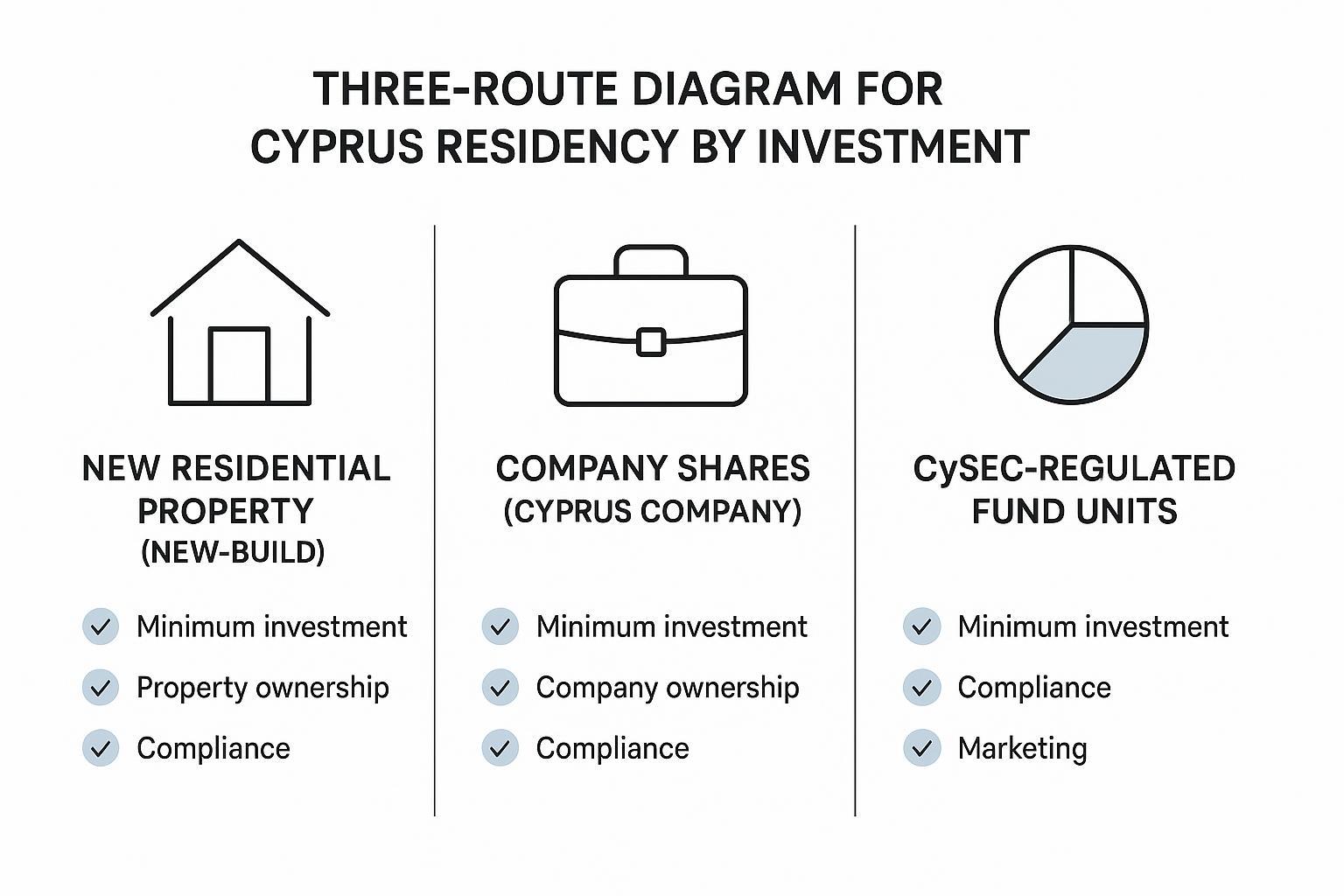
Under Regulation 6(2) guidance, the common residential route is typically a first-sale house or apartment from a development company (i.e., new build), with the minimum investment often described as €300,000 plus VAT where applicable.
The decision-stage checklist I used:
First sale clarity: I made sure it was clearly a first sale from the developer.
Contract-to-bank alignment: I checked that the contract structure and payment schedule mapped cleanly to the bank trail.
Real-life fit: I sanity-checked whether the unit actually fit the family size and the way we planned to use it.
Alternative eligible assets
I also looked at alternatives. They can make sense if the goal is diversification or if there is already a business setup in Cyprus.
In Regulation 6(2) discussions, the common alternatives include:
Company shares: buying shares in a Cyprus company. This may come with real “on-the-ground” requirements, like staff and an office.
Regulated fund units: buying units in certain Cyprus regulated funds.
My simple takeaway: these options can work, but they can add paperwork. They can also add more checks on both the investment and the money trail.
Title and developer checks
It’s easy to underestimate the operational risk of a “beautiful brochure.” What kept me disciplined was focusing on one question:
Could anything later challenge my ownership, my ability to receive title, or the asset’s clean transferability?
Here’s the simple checklist I used with my lawyer (and I wouldn’t skip it):
Title and debts: I checked who really owned the land and whether there were debts or claims attached.
Permits: I checked the project had the right permits for the exact unit I was buying.
Developer track record: I looked at the developer’s history for delivery and title deeds.
Contract safety: I made sure the contract said what happens if timelines or specs change.
⚠️ Warning: Off-plan risk is not only “construction delay.” It can show up as delayed title deeds, unanticipated encumbrances, or weak contractual remedies.
Costs, VAT, and tax residency
The most common budgeting mistake I see (and almost made myself) is treating “€300,000” as the total cost.
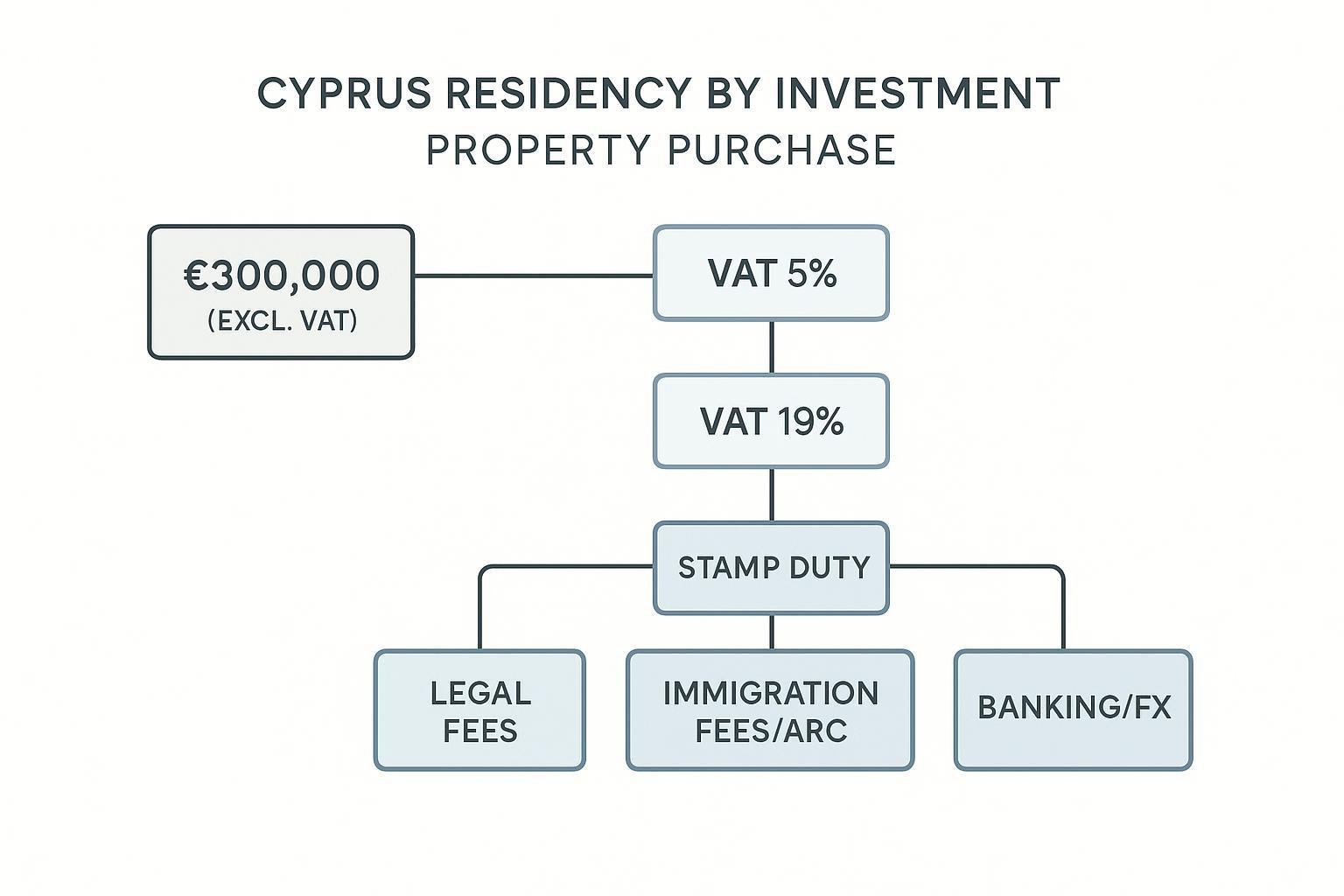
In reality, it’s just the base qualifying threshold. There are extra layers above it.
Purchase cost stack
When I budgeted, I treated the total outlay as a stack of line items—not a single headline number. My list looked like this:
Qualifying investment (often described as €300,000 excluding VAT)
VAT (if applicable)
Stamp duty on the contract
Legal and due diligence fees
Immigration filing / registration fees
Translations, certifications, couriering
Banking/FX transfer costs
For stamp duty and transfer-fee brackets, I checked public summaries first, then had my lawyer apply the correct treatment to my exact transaction (new build vs resale, VAT-paid vs not).
For a high-level view of common fees and process steps, I also used a few public “Golden Visa” checklists as prompts, and then confirmed the current fee schedule at filing.
VAT 5% vs 19%
VAT is one of the biggest swing factors in your total cost.
Simple version: Cyprus has a standard VAT rate (often shown as 19% for new homes). A lower VAT rate (often shown as 5%) may apply if the home is treated as a main home and other rules are met.
When I budgeted for Cyprus reduced VAT 5% primary residence, I treated the reduced rate as conditional, not assumed:
It often depends on whether the home is treated as a main home and whether the other rules are met.
If the home is not a main home, or if it will be rented out, the VAT result may be different.
Because VAT depends on personal facts and rules can change, I confirmed this early. I didn’t sign a contract or lock my budget until my lawyer confirmed the VAT treatment.
PR vs tax residency
Permanent residence status and tax residency are not the same thing.
Permanent residence (PR) is an immigration status tied to compliance and maintenance conditions.
Tax residency depends on tax rules and day-count or other connecting factors.
One more lesson I took from the process: if a move touches education, family office planning, or asset protection, I wouldn’t leave tax planning until “after the residency is sorted.” I’d run tax planning in parallel with immigration.
Cyprus Residency by Investment 2026: Process and Timeline
Decision-stage families win or lose time here based on sequence discipline and document control.
Step-by-step flow
To keep myself sane, I treated the process like a simple checklist:
Choose the route you can document cleanly (property vs shares vs fund units).
Pre-clear money-proof evidence (KYC/SOF): I mapped my money story to the documents I actually had.
Run property due diligence before you lock in: title position, permits, contract protections.
Execute the investment with a bank trail that matches the contract.
Prepare and file with a fully indexed document pack.
Attend biometrics and resolve follow-up queries quickly.
Build your maintenance calendar for annual/periodic compliance items.
If I wanted to reduce avoidable delays, this was the point where a lawyer-led workflow paid off. Transparency note: I found CyprusImmigration while researching and used them as a client during my own process. What helped me most was having the property due diligence and the immigration file managed as one coherent “evidence story,” instead of two separate tracks that only get reconciled at the last minute.
Documents and biometrics
My exact list depended on my family setup and where my documents came from. But this is what I expected:
Passports and civil status documents (marriage, birth)
Clean criminal record certificates (for adults)
Health insurance proof
Proof of secured annual income
Investment documents (contracts, payment confirmations, bank evidence)
Certified translations/legalisation where required
Biometrics usually meant an in-person step in Cyprus at some point in my process.
One decision that saved me stress: I planned travel around document readiness, not the other way around.
Banking trail and compliance
I treated banking as its own timeline. Banks move at their own pace.
The bank-friendly approach I followed:
I moved money early. I tried to avoid last‑minute transfers.
I saved every transfer proof. I labeled it by purpose (reservation, staged payments, balance).
I kept my story consistent across forms, bank statements, and any accountant letters.
If anything in the file was unusual (large gifts, inter-company loans, asset liquidations), I assumed I’d need extra supporting documentation and extra time.
Maintenance duties & exit plan
When approval came through, it didn’t feel like a finish line. For me, it was the start of the “maintenance mindset”: keeping residency continuity safe while preserving investment flexibility.
Keeping PR valid
For my own maintenance checklist, I kept coming back to three ideas:
Retain the qualifying investment (don’t reduce below the required threshold without advice)
Maintain valid health insurance for covered family members
Meet visit/connection requirements (many guides cite periodic visits, such as once every two years)
The way I framed it was “Cyprus PR maintenance plus evidence”: I wanted to be able to prove I stayed compliant if I was ever asked.
Liquidity and exit
A clean exit depended on planning early.
I clarified whether selling the asset would affect the permit under my specific route.
If I wanted liquidity, I thought through whether switching into another qualifying asset would be possible before disposing of the original one.
Because my asset was property, I looked at resale liquidity by location and product type—not just headline pricing.
Risk mitigations
Here are the simple choices I made to reduce regret:
I chose assets with clean title and clean paperwork over “better” units with messy documents.
I used conservative VAT and cost assumptions until my advisor confirmed what applied to my case.
I built a single folder from day one. I kept income proofs, money proofs, contracts, and annual maintenance evidence in one place.
Update notes and sourcing
Here’s how I used posts like this when I was learning:
I treated official sources and written legal advice as the final word. I used public guides like this to plan questions, budgets, and timing.
When I saw numbers like €300,000 or VAT notes (5% vs 19%), I treated them as planning numbers. I didn’t assume they fit my case until my lawyer confirmed.
If anything in my file was “non-standard” (money moving across countries, gifts, company loans, selling assets), I assumed extra documents and extra time.
Conclusion
Cyprus residency by investment in 2026 isn’t complicated in concept, but it can be unforgiving in execution.
Key takeaways:
€300,000 + VAT is not the full budget. It’s the starting line.
The asset matters. But paperwork matters even more.
I didn’t skip due diligence. Title and developer checks protected both my residency and my money.
My timeline moved fastest when my documents and bank trail were clean.
What I did next (and what I’d do the same way again):
I got my documents “filing-ready” early (translations, criminal records, income proofs), because they set the real pace.
I screened developers and projects using a lawyer-led checklist before I let myself get emotionally attached to a unit.
I ran tax planning in parallel so immigration decisions didn’t create avoidable tax consequences.
I picked a timing window that worked with school calendars and banking lead times, instead of forcing everything into an unrealistic month.
This article is not legal or tax advice. I’m sharing what I learned as an applicant, and I still relied on qualified Cyprus professionals to confirm the current rules, fees, and VAT treatment before committing.
Ready to Transform Your Content?
Join thousands of content creators using QuickCreator to produce high-quality content faster. Start your 14-day free trial today.
Start Free TrialRelated Articles